 USA

Nesting Coffee Tables: Small-Space Solutions That Look Great
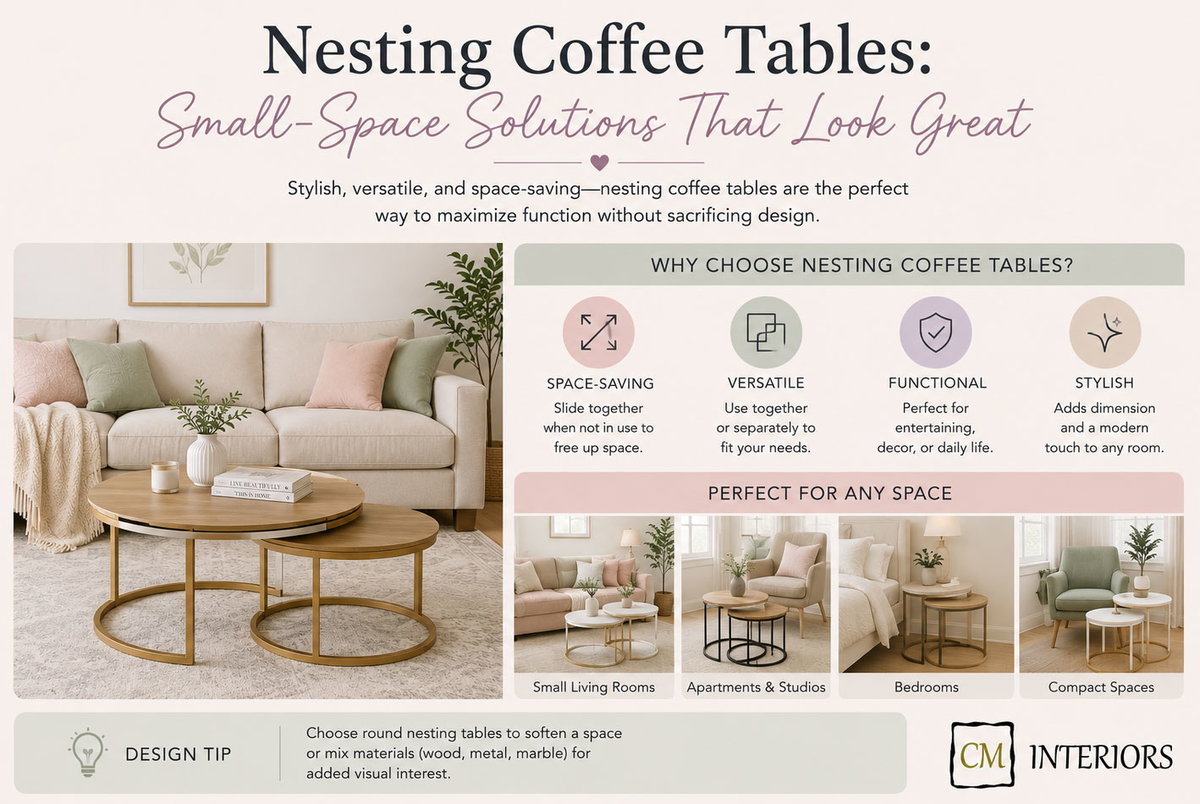
A nesting coffee table set solves a problem that most small-space dwellers know by heart: you need more surface area than your floor plan wants to give you. Two or three tables of graduated sizes slide together into the footprint of one, then pull apart the moment you're hosting, working from the couch, or just want a second spot for a mug and a stack of mail. The format has been around for decades, but it's having a real renaissance right now, driven by shrinking square footage in major cities, the rise of multi-purpose living rooms, and a design culture that rewards furniture doing more than one job.
This piece walks through what nesting tables actually are, how to choose materials and proportions that suit a tight room, how they stack up against other small-space seating options, where to shop for them (including real showrooms worth a visit), and the mistakes that make an otherwise smart purchase look like an afterthought.
What Are Nesting Coffee Tables, Exactly?
A nesting coffee table set is a group of two or, more commonly, three tables built at slightly different heights and diameters so each smaller piece slides underneath the one above it. When pushed together, the set reads as a single object. Pulled apart, each table becomes an independent surface that can migrate to a reading chair, a bedroom corner, or a spot beside the sofa for a laptop and a glass of water.
The format is distinct from a few look-alikes worth naming clearly, since the terms get used loosely online:
- Stacking tables interlock in a fixed sequence and are usually meant to be displayed stacked, more sculpture than furniture.
- Modular coffee tables are single units with removable sections, like a large square table that splits into two rectangles.
- Side table trios are simply three unrelated tables sold as a set, without the graduated sizing that lets them tuck together.
True nesting tables earn the name because of that graduated fit. The smallest table typically measures 12 to 16 inches across, the middle 16 to 20 inches, and the largest 20 to 26 inches, though dimensions vary widely by brand and style.
Why Nesting Tables Are Having a Moment
A few converging trends explain the current interest in this old furniture format.
Smaller footprints, same expectations. Studio and one-bedroom apartments in dense cities haven't grown, but the expectations for how a living room should function have. People want a coffee table that can hold a laptop during the day and a charcuterie board on a Friday night, without needing two separate pieces of furniture to do it.
The end of the fixed living room. Remote and hybrid work turned living rooms into occasional offices. A nesting set lets one table detach and travel to wherever the workday is happening, then return to its place when the day ends.
A shift toward visual lightness. Interior design in the past several years has leaned into rooms that breathe — lower profiles, exposed floor, furniture that doesn't visually block sightlines. A nesting set, especially in glass or a slim metal frame, takes up a fraction of the visual weight of one large table, even when the combined surface area is similar.
Rental-friendly flexibility. Renters move more often and more unpredictably than homeowners historically did. A single large coffee table might not suit the next apartment's proportions; a nesting set, because each piece is independently useful, almost always finds a role in whatever room comes next.
The Anatomy of a Great Nesting Set
Not every nesting set is created equal, and the difference between one that reads as intentional design and one that reads as an afterthought comes down to three things: material, shape, and proportion.
Materials That Work Hardest in Small Rooms
Material choice matters more in a small room than a large one, because every surface is doing double duty — visually and functionally.
- Glass and acrylic tops are the classic small-space move because they're visually transparent. Light passes through, floor space reads as open, and the table almost disappears when you step back and look at the room as a whole.
- Light wood (oak, ash, birch) keeps the warmth of a traditional coffee table without the bulk of a dark, heavy finish. It photographs well and tends to suit a broad range of decorating styles, which matters if you plan to keep the set through a few different apartments.
- Metal frames, especially in slim tube steel or brass, add structure without adding mass. A metal-framed nesting set with a stone or glass top is one of the more popular combinations in mid-range and higher-end lines right now.
- Mixed materials — a wood top on a metal base, for instance — give each table in the set a bit of individual character while keeping a unifying element (usually the base finish) tying them together.
Dark, solid wood or heavy stone can still work in a small room, but they demand more restraint elsewhere in the space to avoid visual crowding.
Shapes and Silhouettes
Round nesting tables tend to suit small rooms best because they eliminate sharp corners in tight walking paths — a real consideration when a coffee table sits close to a doorway or a sofa's traffic line. Rectangular sets offer more usable surface area per table and pair naturally with a sectional. Organic, free-form shapes (kidney curves, asymmetric ovals) have become more common in the past few years and photograph beautifully, though they can be harder to place flush against a wall if you need the option to push the set aside.
Sizing and Proportions
A nesting set that's too small for the room disappears into the floor plan; one that's too large defeats the purpose of choosing a space-conscious format in the first place. Two rules of thumb hold up well in practice:
- The largest table in the set should measure roughly two-thirds the length of the sofa it sits in front of.
- The tallest table's height should land within two inches of the sofa seat cushion's height, give or take, so drinks and plates sit at a comfortable reach without requiring a lean forward.
Measure the space between the sofa and any opposite seating before buying. Eighteen inches of clearance is the generally accepted minimum for comfortable walking room around a coffee table.
How to Style Nested Tables Like a Designer
The styling opportunity with a nesting set is different from a single coffee table, because you're arranging across multiple surfaces of different heights rather than one flat plane.
- Stagger the heights on purpose. Pull the smallest table slightly forward and place a stack of books or a small vase on it, then let the taller table hold a tray. The height variation does visual work that a single flat surface can't.
- Leave negative space. One of the most common styling mistakes is filling every table in the set. Let at least one surface stay mostly empty; it reads as intentional rather than cluttered.
- Use a tray to unify a spread-out arrangement. If you've pulled tables apart to different corners of the room, a matching tray on each one (even a small one) creates a visual thread between them.
- Mix textures over mixing everything. A ceramic vase, one stack of hardcover books, a single plant — that's enough. Small tabletops get visually noisy fast.
- Let the tables separate when needed. Half the appeal of the format is functional, not decorative. Don't feel obligated to keep them nested at all times; a table pulled beside an armchair for a cup of coffee is the set doing its job.
Nesting Tables vs. Other Small-Space Coffee Table Options
Nesting sets aren't the only answer to a tight living room, and they're not always the right one. Here's how they compare to the other formats people consider.
| Feature | Nesting Tables | Single Coffee Table | Stacking/Modular Tables | Storage Ottoman |
|---|---|---|---|---|
| Footprint when not in use | Very small — tables tuck together | Fixed, moderate to large | Small when stacked | Moderate, fixed |
| Flexibility | High — each table can move independently | None | Moderate — sections rearrange but rarely leave the group | Low |
| Surface area available | High when pulled apart | Moderate, fixed | Moderate | Low — soft top isn't ideal for drinks or laptops |
| Storage | Rare, unless a table includes a shelf | Common in trunk-style designs | Occasional | Excellent — usually the main selling point |
| Best for | Studios, multi-use living rooms, frequent hosting | Traditional living rooms with fixed layouts | Minimalist or sculptural spaces | Spaces needing hidden storage over surface space |
| Typical price range (USD) | $150–$900 for a set | $200–$1,200 | $250–$1,000 | $100–$500 |
| Visual weight | Light, especially in glass or metal | Varies by material | Light to moderate | Heavier, upholstered bulk |
A nesting set wins on flexibility and visual lightness. A storage ottoman wins if hidden storage matters more to you than tabletop surface. A single coffee table still makes sense in a room with a fixed, generous layout where flexibility isn't a priority.
Where to Shop: Brands and Showrooms Worth a Visit
Online shopping covers most of what you'll need, but seeing scale and material quality in person is worth the trip if you're near a showroom, since nesting tables photograph more uniformly flattering than they sometimes feel in person.
CB2 carries some of the more design-forward nesting sets on the market, often in acrylic, marble-look composite, and mixed metal finishes. Two Manhattan locations worth a visit are the Midtown East store at 979 3rd Ave, New York, NY 10022, and the SoHo store at 451 Broadway, New York, NY 10013.
West Elm leans into warm wood tones and mid-century-influenced silhouettes, and its nesting sets tend to sit at a friendlier price point than CB2's. In New York, the Chelsea store at 112 W 18th St, New York, NY 10011, and the Upper West Side location at 1870 Broadway, New York, NY 10023, both carry a rotating in-store selection.
Crate & Barrel stocks a broad range from budget-conscious to investment-piece nesting sets, with a large SoHo location at 881 Broadway, New York, NY 10003, housed in the historic Cable Building.
Article is an online-only retailer that has become a go-to for mid-century and Scandinavian-influenced nesting sets at prices generally below the big-box design retailers, without the showroom overhead.
IKEA remains the budget entry point for the category, with several nesting table lines that have stayed in the catalog for years because they simply work for the price.
Floyd focuses on modular, easy-to-move furniture and offers a small but well-reviewed nesting table option built with sustainability and disassembly in mind.
Etsy is worth a search for handmade or vintage-style nesting sets, particularly in solid wood, from independent makers — a good route if you want something that won't show up in every apartment on your block.
For inspiration before you buy, Apartment Therapy and The Spruce both run recurring small-space furniture roundups, and Houzz is useful for browsing real living rooms photographed at true scale rather than staged showroom shots.
Budget Breakdown: What to Expect at Every Price Point
Under $200. Expect laminate or veneer tops, often on a simple metal hairpin-style base. Perfectly functional for a first apartment or a secondary room, though the finish tends to show wear within a couple of years of daily use.
$200–$500. This is where most mid-range sets from West Elm, Crate & Barrel, and Article live. Solid wood tops, tempered glass, and better-finished metal bases become standard, and construction quality improves noticeably.
$500–$900. Marble, terrazzo, and higher-end mixed-material sets sit in this range, along with designer collaborations. At this price, expect the kind of finish and hardware quality that holds up over a decade of use rather than a few years.
Above $900. Vintage originals, designer editions, and custom-made sets from independent woodworkers occupy the top end. Buying here is usually about a specific aesthetic or provenance rather than incremental functional improvement over the $500–$900 range.
Common Mistakes to Avoid
Buying a set that's too small for the room. A tiny nesting set in a living room built around a large sectional looks like it wandered in from a dollhouse. Measure the sofa first, then shop.
Choosing three tables that are too visually similar. Part of the appeal of nesting sets is the graduated, layered look. If all three tables share an identical finish and shape with no variation in height or material accent, the set can read as flat rather than layered.
Ignoring stability. Because nesting tables are often built light for portability, cheaper sets can wobble under a laptop or a full glass. Check reviews specifically for stability before buying, especially with metal-legged designs.
Forgetting the underside. Nesting requires the smaller table's top to clear the larger table's underside supports. A few budget sets have shallow clearance that makes nesting awkward in practice — worth checking dimensions or reviews before ordering online.
Treating the set as purely decorative. The best nesting sets are functional first. If a set is too delicate for a mug of coffee or a laptop, it's solving the wrong problem for a real living room.
Design Ideas by Room Type
Studio apartments. A round, three-piece glass or acrylic set keeps sightlines open across the whole room — important when the living, sleeping, and sometimes working areas share one continuous space.
Living rooms with a sectional. A rectangular nesting set matches the sectional's linear geometry better than a round one and gives enough combined surface area for a group gathering when pulled apart.
Home office corners inside a living room. Pull the smallest table from the set over to a reading chair or a window nook to create an impromptu desk, then push it back when the workday ends.
Small balconies or reading nooks. A single small table from a nesting trio, left permanently detached, is often the most-used piece in the whole set — proof that the format's real value is in the separation, not just the tidy nested silhouette.
Sustainability and Longevity Considerations
Because a nesting set is really three (or two) separate pieces of furniture, material sourcing matters more here than with a single coffee table — you're multiplying the footprint of whatever material you choose. Solid wood from a responsibly managed source, or a brand that discloses its manufacturing supply chain, tends to age better and holds resale value better than laminate-over-particleboard construction, which is worth the modest price premium if the set is meant to last through a few moves rather than one apartment.
Buying secondhand or vintage, particularly through Etsy or local marketplaces, is one of the more sustainable ways to acquire a nesting set, since solid-wood originals from earlier design eras were often built to a standard that's hard to find at the same price point new.
Frequently Asked Questions
Are nesting coffee tables sturdy enough for everyday use?
Mid-range and higher sets from established retailers hold up fine under normal use — drinks, laptops, feet occasionally resting on the lower table. Budget sets under roughly $150 are more prone to wobble, particularly with thin metal legs, so it's worth reading reviews for stability specifically before buying at that price point.
Can a nesting set fully replace a traditional coffee table?
In most living rooms, yes. The combined surface area of a three-piece set pulled apart typically exceeds what a single coffee table offers, and the format adds flexibility a fixed table can't match. The one exception is a household that relies heavily on under-table storage, since few nesting sets include it.
What's the best material for a home with kids or pets?
Solid wood with a durable sealed finish tends to outperform glass for households with kids or larger pets, since it resists chipping and doesn't show fingerprints and nose prints the way glass does. Rounded corners are also worth prioritizing over sharp rectangular edges in an active household.
How many tables should a nesting set include?
Three is the most common and versatile configuration, giving enough size variation to serve different purposes. Two-table sets work well in especially tight studios where even a third small table would crowd the floor plan.
Do nesting tables work with a large area rug?
Yes, and they typically work better than a single bulky table, since the smaller footprint leaves more of the rug's pattern visible when the set is nested together.
Final Thoughts
A nesting coffee table set is one of the rare furniture purchases that gets more useful as your space gets smaller, rather than less. The format rewards a bit of upfront measuring and a willingness to prioritize function over a single showpiece object, and it pays that consideration back every time a table needs to travel across the room to do a job a fixed table never could. Whether the budget points toward IKEA or a solid-wood vintage find, the same principles hold: measure against the sofa, choose a material that matches how the room actually gets used, and leave enough visual breathing room between the pieces to let the set look composed rather than crowded.