 USA

Sideboard vs. Buffet vs. Credenza: What's the Difference?
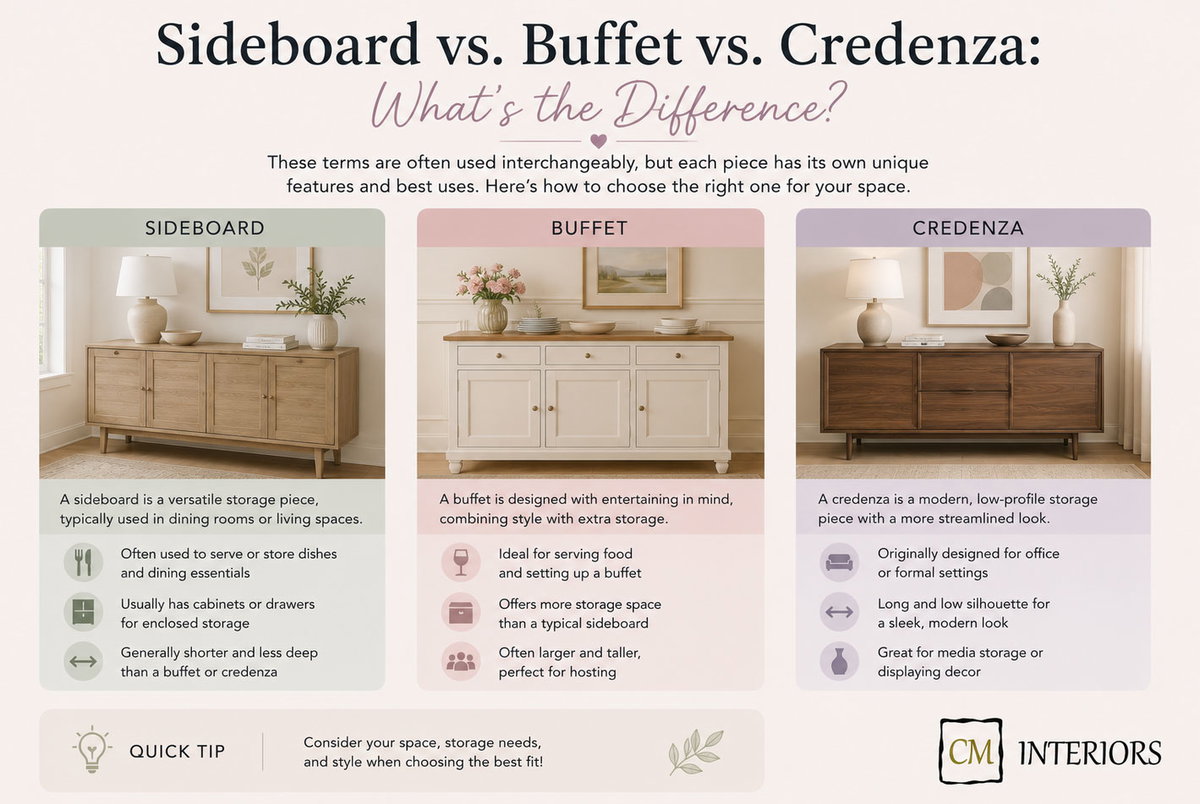
Walk into any furniture showroom or scroll through an online catalog, and you'll notice something odd: three pieces that look nearly identical are sold under three completely different names. One salesperson calls it a buffet. Another labels the same silhouette a sideboard. A third insists it's a credenza. Customers leave more confused than when they walked in, and honestly, they have every right to be.
The truth is, these three terms have overlapping histories, borrowed features, and regional quirks that blurred their definitions over the last two centuries. But they aren't interchangeable — not if you ask a furniture historian, an interior designer, or anyone who has ever tried to order the "right" piece for a specific room and ended up with something that doesn't fit the function they needed.
This guide breaks down the real distinctions between a sideboard, a buffet, and a credenza — where each one came from, how they're built, where they belong in a home, and how to choose the correct one without relying on guesswork or a salesperson's best guess.
Why These Three Pieces Get Confused So Often
Furniture terminology evolves the way slang does — usage drifts, marketing departments simplify things for search engines, and regional dialects blend together until the original meaning gets diluted. Add in the fact that all three pieces share a similar job description (storage plus a flat surface for display or serving), and it's easy to see why retailers use the words as if they were synonyms.
But the differences aren't just semantic. They involve height, depth, leg style, door configuration, historical function, and even the room they were originally designed to serve. Knowing these details actually matters if you're trying to furnish a space with intention rather than just filling a wall.
What Is a Buffet?
A buffet is a long, low storage cabinet traditionally used in dining rooms to hold serving dishes, linens, and silverware. The term comes directly from the French word "buffet," referring to a side table used for serving food during formal meals. In 17th and 18th century France, buffets were substantial pieces — often with marble tops, ornate carvings, and multiple tiers — used to display wealth as much as dinnerware.
Structurally, a buffet tends to sit low to the ground, usually between 30 and 36 inches tall, with a long horizontal design that can stretch anywhere from 60 to 90 inches wide. It typically features cabinet doors on the lower half, sometimes with drawers above them for cutlery or table linens. Legs are common, though shorter and sturdier than what you'd find on a sideboard.
The defining trait of a buffet is its purpose: serving. It's meant to hold warm dishes, stacks of plates, and serving utensils within arm's reach of a dining table, functioning almost like a staging area during a meal.
Key Characteristics of a Buffet
- Long, low profile designed for a dining room
- Traditionally paired with a hutch on top (buffet-and-hutch sets)
- Cabinet storage plus drawers for table linens and utensils
- French origin, associated with formal dining service
- Often heavier and more ornately detailed than a sideboard
What Is a Sideboard?
A sideboard originated in England during the Georgian and Regency periods, evolving as an aristocratic dining room fixture. Unlike the buffet's serving-focused design, sideboards were built with elegance and symmetry in mind — flanking drawers, a central cabinet, and often a raised gallery rail along the back edge to prevent dishes or decanters from sliding off.
Sideboards tend to stand slightly taller than buffets, often between 34 and 38 inches, and they lean more toward refined joinery and decorative detailing. Historically, sideboards were status pieces in wealthy homes, showcasing silverware, china, and glassware for guests to admire before and after a meal.
Today, "sideboard" is often used as a catch-all term in modern retail, especially for mid-century and Scandinavian-inspired designs with tapered wooden legs, sliding doors, and minimalist hardware. This shift has blurred the line between sideboards and buffets in casual usage, but traditionally, the sideboard carries more architectural refinement and slightly taller proportions.
Key Characteristics of a Sideboard
- English origin, tied to formal dining traditions
- Slightly taller and narrower than a traditional buffet
- Often features tapered legs and finer joinery
- Popular in mid-century modern and Scandinavian design
- Used for both storage and display of tableware
What Is a Credenza?
The credenza has entirely different roots — coming from Italian Renaissance households, where it originally served as a food-tasting table. Servants would place dishes on a credenza before serving royalty, partly as a precaution against poisoning. The word "credenza" itself derives from the Italian verb "credere," meaning "to believe" or "to trust."
Over the centuries, credenzas shifted away from dining rooms and became associated with offices and studies. Unlike the buffet or sideboard, a credenza is typically low, flat-fronted, and boxier — often lacking ornate legs altogether, instead sitting close to the floor on a plinth base. This low, streamlined shape made it a natural fit for modern office furniture, especially behind an executive desk or along a conference room wall.
Modern credenzas are frequently used for media storage in living rooms too, housing televisions, sound systems, or gaming consoles. Their flat-front doors and lack of ornamentation give them a clean, contemporary look well-suited to minimalist interiors.
Key Characteristics of a Credenza
- Italian origin, historically linked to food-tasting rituals
- Low profile with a flat, boxy silhouette
- Minimal or no legs — often sits on a plinth base
- Common in offices, studies, and media rooms
- Associated with modern and contemporary design movements
Sideboard vs. Buffet vs. Credenza: Comparison Table
| Feature | Buffet | Sideboard | Credenza |
|---|---|---|---|
| Origin | France | England | Italy |
| Historical Use | Formal dining service | Display of china and silverware | Food-tasting before serving |
| Typical Height | 30–36 inches | 34–38 inches | 28–32 inches |
| Leg Style | Short, sturdy legs | Tapered or slender legs | Minimal legs or plinth base |
| Design Detail | Ornate carvings, marble tops (traditional) | Refined joinery, gallery rail | Flat-front, minimalist |
| Common Room | Dining room | Dining room | Office, study, living room |
| Modern Use | Dining storage, serving surface | Dining or living room storage | Media console, office storage |
| Storage Type | Cabinets plus drawers | Cabinets, drawers, sometimes shelving | Cabinets, often with cable ports for media |
| Style Association | Traditional, formal | Mid-century modern, transitional | Contemporary, minimalist |
Height and Proportion: The Most Reliable Way to Tell Them Apart
If you're standing in front of a piece of furniture and trying to identify it without a tag, proportion is your best clue. Credenzas sit lowest to the ground, often under 32 inches, because their original function required easy access without obstructing sightlines in an office or reception area. Buffets sit a bit taller, generally in the 30 to 36 inch range, since their job was to support serving activity at roughly waist height for someone standing beside a dining table. Sideboards typically top out the tallest of the three, sometimes approaching 38 inches, reflecting their more decorative, display-oriented function.
Legs matter too. A piece with tall, tapered wooden legs and visible daylight underneath is far more likely to be a sideboard. A piece that sits flush to the floor, boxy and grounded, is almost certainly a credenza. Buffets fall in the middle — legs are present, but shorter and less delicate.
Room Placement: Where Each Piece Actually Belongs
Dining Rooms
Both buffets and sideboards were built with dining rooms in mind, but they serve slightly different roles. A buffet works well when you need serving space directly adjacent to the table — somewhere to stage dishes, warm plates, or a coffee station during a dinner party. A sideboard, meanwhile, leans more toward display: showcasing china, glassware, or table linens behind glass-front doors or open shelving.
Living Rooms
Credenzas have become the default choice for living rooms, largely because their low, flat-front design pairs naturally with wall-mounted televisions and sound equipment. Many modern credenzas include cutouts for cable management, ventilation slots for electronics, and adjustable shelving for streaming devices or game consoles.
Home Offices
A credenza's understated, low-profile design also makes it a natural fit for a home office, particularly behind a desk or along a wall used for filing and printer storage. Because credenzas were historically associated with formal business settings in Italy, this modern use is arguably closer to their original spirit than either the buffet or sideboard.
Entryways and Hallways
Sideboards, thanks to their slightly narrower depth and refined detailing, often double as entryway consoles in smaller homes — holding mail, keys, and decorative objects near the front door.
Materials and Style: How Design Movements Shaped Each Piece
Traditional buffets, especially those built in the 18th and 19th centuries, leaned heavily on solid woods like mahogany, walnut, and oak, often finished with brass hardware and occasionally marble or granite tops. This gave them a heavier, more formal presence suited to grand dining rooms.
Sideboards followed a similar traditional path initially but adapted more fluidly to changing design movements. During the mid-century modern era of the 1950s and 60s, sideboards were reimagined with teak and walnut veneers, tapered legs, and sliding doors — a look that remains extremely popular in furniture retail today, often marketed simply as "mid-century sideboards."
Credenzas, by contrast, embraced modernist and minimalist aesthetics almost from the moment they entered mainstream Western furniture design in the 20th century. Clean lines, lacquered finishes, and geometric hardware define most contemporary credenzas, which explains why they feel so at home in modern offices and media rooms.
Common Misconceptions Worth Clearing Up
"A buffet always comes with a hutch." Not necessarily. While traditional buffet-and-hutch combinations were common in formal dining sets, many modern buffets are sold as standalone pieces without the upper hutch component.
"Sideboard is just a British word for buffet." There's some truth here historically, since both pieces emerged from European dining traditions around the same era. But the design differences — particularly around height, leg style, and decorative detailing — are real distinctions that furniture historians and designers still recognize.
"Credenzas are only for offices." This was true for much of the 20th century, but credenzas have become a dominant choice in contemporary living room and dining room design, largely replacing bulkier buffets and sideboards in homes that favor minimalist aesthetics.
"They're all just cabinets with doors." Functionally, yes — all three provide enclosed storage. But the proportions, historical intent, and stylistic details are different enough that interior designers treat them as distinct furniture categories, not synonyms.
How to Choose the Right One for Your Space
Start with function. If you regularly host dinner parties and need a surface for serving dishes near the table, a buffet is the traditional and practical choice. If you want a piece that doubles as both storage and a visual display for glassware, china, or decorative objects, a sideboard offers more refined proportions and often better lighting for showcasing items behind glass doors.
If your priority is media storage, cable management, or a clean look behind a desk, a credenza's low profile and minimalist design will almost always outperform the other two options. Credenzas are also the better choice in smaller rooms where a tall sideboard or bulky buffet would visually overwhelm the space.
Measure your wall space carefully before choosing. Because buffets and sideboards run wider and taller on average, they need more visual breathing room. Credenzas, being lower and often more compact, integrate more easily into tighter layouts like apartments or open-concept living spaces.
Consider your existing design language too. A mid-century modern living room calls for a sideboard with tapered legs and warm wood tones. A traditional dining room with a formal table setup pairs naturally with a classic buffet. A contemporary office or media wall almost always looks better with a streamlined credenza.
Where to See Real Examples and Compare Styles
If you want to compare actual pieces side by side before making a decision, several established design resources offer extensive galleries and buying guides worth browsing:
- Architectural Digest frequently publishes design breakdowns and historical context on dining and storage furniture.
- Design Within Reach carries curated mid-century sideboards and modern credenzas from recognized designers.
- Crate & Barrel offers a wide range of buffets, sideboards, and credenzas across multiple price points and finishes.
- The Spruce publishes accessible home design guides that often compare furniture terminology and room placement.
- Apartment Therapy covers small-space furniture solutions, which is useful if you're deciding between a compact credenza and a larger sideboard.
- Better Homes & Gardens offers styling advice for dining rooms and living spaces that frequently touches on buffet and sideboard placement.
Browsing a few of these side by side, rather than relying on a single retailer's labeling, tends to make the visual and functional differences click much faster than reading descriptions alone.
Frequently Asked Questions
Is a credenza the same as a sideboard? No. While both provide enclosed cabinet storage, credenzas are lower to the ground, often lack decorative legs, and originated from Italian office and reception furniture traditions rather than English dining room customs.
Can a buffet be used in a living room? Yes, though it's less common. Buffets can work well as media consoles or storage pieces in a living room, but their taller, bulkier proportions make credenzas a more popular modern choice for that specific use.
Which is more formal: a sideboard or a buffet? Both carry formal dining associations, but sideboards historically leaned slightly more toward display and refinement, while buffets were built primarily for serving function during meals.
Do sideboards and buffets have the same storage capacity? Generally similar, though buffets sometimes include additional drawer space specifically designed for table linens and silverware, while sideboards may allocate more room to open shelving or glass-front display sections.
What's the best piece for a small apartment? A credenza is usually the most space-efficient option thanks to its lower height and flatter profile, making it easier to fit into tighter living rooms or studio apartments without overwhelming the space.
Why do retailers use these terms interchangeably? Largely for search visibility and simplicity. Because all three pieces serve an overlapping storage function, retailers often use whichever term is most commonly searched, even if it's not historically accurate to the specific design.
The Bottom Line
A buffet, a sideboard, and a credenza all solve a similar problem — providing storage and surface space in a room — but they arrived at that solution through very different histories and design priorities. The buffet grew out of French dining service, the sideboard out of English aristocratic display, and the credenza out of Italian formality that eventually found its modern home in offices and media rooms.
Understanding these distinctions isn't just trivia for furniture enthusiasts. It genuinely helps when you're trying to furnish a specific room with a piece that matches both its function and its proportions. A dining room built around formal entertaining calls for a different silhouette than a minimalist living room centered on a wall-mounted television, and knowing the real differences between these three pieces makes that decision considerably easier.